
How to measure up the GTM Libra suspension settings
Followed by a how to make up a really quick to use setup tool (here)
This is an explanation of how I measured my Libra in order to set up the rear track, rear camber, and front and rear toe-in.
THIS ASSUMES THAT YOU HAVE SET THE RIDE HEIGHT AND BOUNCED UP AND DOWN ON THE CAR TO SETTLE IT FIRST!! AND THAT YOU ARE WORKING ON A LEVEL FLOOR.
In the build manual for the Libra there is a complicated explanation of how to adjust the rear wishbones to give the correct track, which should be set to equal the front. However, once you set the rear track by measuring the distance from the outer faces of the gearbox casing to the centre-line of the innermost bolt securing the lower ball joint.....well it all seemed a bit complex and not too precise to me. So I rang the factory, where they told me that in practice they actually use strings and measure off from a couple of datum points on the car to set everything up ready for the road.
The following is my suggestion for how to do this. Once set up, the strings make wheel alignment measurement really easy.
The first thing is to set up two strings parallel to the side of the car. Bear with me, the effort will be worth it. No actually the first thing is to establish that the steering rack is in the centre point of its' travel. Do this now to avoid having to reset the strings later! Turn to full lock in one direction. Mark position of steering wheel. Turn to full lock in the other direction, counting turns from the position of the steering wheel. Now unwind half the counted number of turns, and the rack is now in the mid position. Re- position the steering wheel so that is pointing straight ahead. So, when you set the front wheels to point in the correct straight ahead position, you will line them up with the centralised rack. Roll the car back and forth a couple of times to relieve the tension in the tyres - keeping the steering wheel straight, it may well try to move a bit off centre due to the mis-alignment of the wheels.
Now set the strings lines alongside the car.
In order to get the strings parallel, I made up two lengths of timber each with a lines and 'V' cuts for the strings which I chose to be 2m apart. I placed these across the front and back of the car on axle stands so that the string would be at wheel centre height. These will then ensure that when strings with weights on are placed from front to back alongside the car and over the timber lengths the equal dimensions A in the drawing would be maintained. The relationship between the two timber supports 'A' and the actual strings needs to be so that the strings are parallel. To do this I used a large square to make sure that the angles between the strings and the timber supports were at 90° (I used a roofing square, but you could make a large one up from scrap laths making a 3/4/5 triangle).
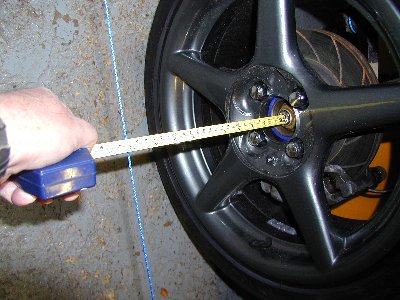
Now comes the fiddly bit. Adjust the position of the strings so that the distance from the end of the front stub axle to the string is the same each side as in dimension 'B' above. Like this:
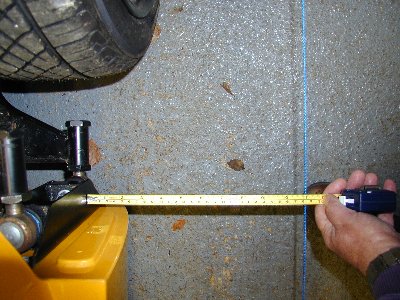
AND...check that the dimension each side from the outer rear suspension mounting bracket to the string is the same each side. Like this:
SOME TIME LATER.....when you have adjusted the string supports from side to side and checked for 90° again so that dimensions A and B are equal on each side of the car, you now have two strings which are parallel to the car, and from which you can measure to the wheel rims and hub centres to make the suspension set-up adjustments. Now mark the centre point of the front string support and the corresponding point on the car. I did this with the front clamshell removed, and placed the front support up against the radiator mounting - you may be surprised where the middle of the car is!
FRONT TOE IN. (I'm not making recommendations on settings, just outlining the method - this can be a -ve or +ve setting)
Do both sides
NOW....since we have moved something which we used as a datum, check the string line positions again. The end of the stub axle is some way out side the pivot point, so it will alter the measurements a bit. It won't have altered it much, but re-check the alignment of the strings.
REAR WHEEL ADJUSTMENT
The rear wisbones need to be adjusted so that the rear wheels have the correct camber and track.
Measure the camber first. The recommendation is for about -2°. I calculated that for my wheels which are 440mm rim diameter, I would need to have the top of the wheel 15mm in from the vertical. So I made a camber gauge up using one pice of wood to fit my spirit level into the wheel rim and not the tyre, and then placed an additional piece 15mm thick on the upper end. I then taped this to my spirit level.

The track is measured in the same way is the front datum is set, i.e. from the end of the stub axle to the string. Adjustment of the track and camber is made by altering the outer ball joint adjusters on both the upper and lower wishbones. If you alter the top wishbone to increase the -ve camber, you will also make a slight inward adjustment of the centre of the wheel which will reduce the track. Therefore, if you know which way you need to go to get the camber correct, you will be able to decide which wishbone to make most of the adjustment on. Altering one wishbone will change both camber and track.
After each adjustment bounce up and down on the car to settle it.
After you have set front and rear both sides, drive the car up and down your driveway and then re-measure. (this where marking the mid point of the front string support comes in real handy!
HOW TO MAKE AN EASY TO USE SETUP TOOL
Now I have the dimension which give me the difference in the lengths B & C, I can make a measuring rod to do each side of the car without setting up the strings. All I have to do will be to set the bar up against the datum points on the side of the car and measure off from it.

On my car the difference between the lengths B and C is 27mm.
So I took a 3m length of prepared board 130mm X 20mm.
I then fixed on it two pieces of aluminium angle which would project out from the side of the board at 100mm at the position for the front wheel hub, and 127mm at the position for the rear suspension mounting bracket.

To set the car up, all I need to do now is place the board on suitable stands so that it is at wheel centre height and push it in until the two angle projections are touching the reference points. Now all my measuring is done straight off the board.
